“Exercising, cooking and even cleaning are the activities I can do while having online class”
Online learning has been conducted on for most Australian universities and colleges since the beginning of this year, and not all students like the idea of home learning. In particular, most International Students feel that there are unfair elements in the payment of the university fee.
Jocelyn Calandra (19), an international student from Indonesia who never set her feet in Sydney as she just started her Foundation Course in University of New South Wales (UNSW) Global on March, say “there is no reduction on the paying the college’s fee and yet I will never able the opportunity to use any of the services and facilities provided by the college”.
In fact, “it’s sometimes frustrated for me to search for the material that I need online, as I prefer to go to the library.” Being unable to enjoy all the facilities provided by the College, and yet still having to pay the full price, may be unfair to her, but not everyone feels the same as her.
Nguyen Ngoc Thao My (19), a first-year student in University Technology Sydney (UTS) who from Vietnam said, “There are more services that I received from University than before and those services help me to get through this situation’’. Services such as Online learning centre (OCL) has allowing Vietnamese student to receive help with the academic learning from the staff. However, this service is not available in other countries besides China and Vietnam.
It may take time for most international students to be able to cope with online learning, and more effort is needed compared to local students. Due to the pandemic, the majority of international students are in their home country and the time zone difference has impacted their daily routine.
Calandra says “it is totally weird for me to be the only person in my family to have a different schedule” as sometimes she has morning class which is at 8 a.m. (AEST) and need to be awake and be ready for class at 5 a.m (WIB).
In addition, for a medical student, Seysomaly Heng (19) who need to do most of her practical experiment online feels that it is difficult as to set up her own instrument and follow the procedure while doing it at home. She also adds, “it is just like a self-learning with an addition of me watching my lecturer who giving an instruction on Zoom”.
“There are always so much work I need to prepare before class, on of it is to make sure my internet concection is on and sometimes there would be any of my family member who may disturb me” said Heng.
However, remote learning still could be really enjoyable and saving a lot of their time. Nguyen Ngoc talks about the time she can spend with her family while having class at home. “There is more time that I have spent with my family now and in fact, sometimes we go for a vacation within in Vietnam and I still be able to attend class”. The bonding with her family has allowing her to spend more quality time with them compared to before the pandemic.
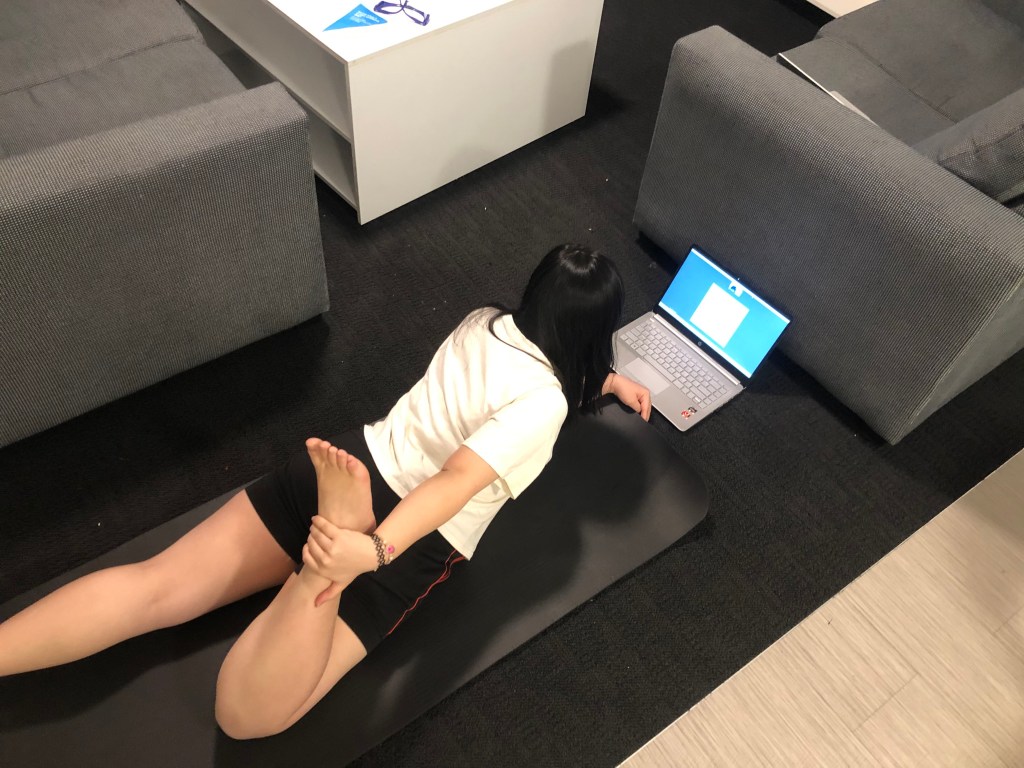
Similarly, Heng who feels remote learning enables her to do more activities which she enjoys such as doing simple workout while listening to the lecturer. “Exercising, cooking and even cleaning are the activities which I can do while having online class”. As a result, she feels that she has develop a multitasking skill. “I am still engaging with the class’s activity while I am cooking and there were once when I actually the teacher wants me to turn the camera on and seeing me with an apron”.
Moreover, Calandra, who also has similar experience, while cleaning her pet’s dirt and, unfortunately, the teacher wants to see every student’s face, and when she turns on the camera, most of her peers are shocked and laughed. “I didn’t realise that there was a dirt mark on my t-shirt, and I just turned on the camera, and then, without knowing anything, most of my peers were surprised and texted me through an individual zoom chat to let me know that my clothes had my dog’s waste.”
It may seem unethical to do this while having a class, but it’s common for a student to actually do another activity behind the camera. “It’s not just me who can have fun with my family while having an online class, there’s a lot more people doing that,” Nguyen Ngoc says. Heng also adds, “Most of my peers, I know, will also do other activities they enjoy while learning online.”
The research conducted last year by Andrew Lepp, Jacob E. Barkley, Aryn C. Karpinski, and Shweta Singh has shown that students who attending online classes tend to be less engaged in the classroom and have more engaged online or offline activities compared than student who are in the face to face class.
There is a viral photo of a grab driver attending his online class between delivering food to the Philippines. Francis John Ax Valerio told Clara Rosales that time management is the most important thing, as he would take a pause from the delivering if there is online class. He is working in order to support his family and at the same time he does not want to miss his education. Hence, has decided to use his time wisely by juggling between work and study.
For some student, they simply view online class something that is less serious, due to there is no presence of lecturer. “Sometimes it just feels like I am watching a live video instead if actually feel like having a class.’’ And again, listening and watching the two hours lecture or even longer than that through Zoom has resulting most of the student to feel boring and tired.
“Normally, in class, my friend and I can have a conversation or discussion about the lecturer’s topic, but there is less interaction between my friend and I”, Nguyen Ngoc says. This the reason why most of the student are doing other activities to keep them engaging in class.
Calandra’s experience is unimaginable that she also does not have a friend from her current class “ever since the foundation course began, I have never experienced going to campus and even never been to Australia, while in the zoom, I am barely approaching my classmate because I don’t know who and what kind of people they are, and now I still do not anyone who is in my class and have no friend.” Perhaps she is shy of asking people who she knows about the text, but it is more about feeling insecure rather than shy.
Even Nguyen Ngoc who also known to be a friend girl among her friends, also feel the same about it. She says, “the most difficult problem about having class online is the struggle of making new friend and expanding social relationship”. This is just one of the ugliness of learning online that has impacted the student’s life. “I feel become discourage as I cannot discuss certain topic that I do not understand with other peers” Heng adds.
Although it seems sorrowful to have no friend but most of the student still finding it interesting about having class online. In fact, it could be a possibility of student having a remote learning in the future and not going back to the campus anymore. “things are absolutely changing and evolving over time and I am excited to see in 10 years later if people still willingly to go to campus or not?” Heng tells me.
Calandra has also mention that she is adapting pretty well with online learning and other activities “I feel it is new normal to see my friends and other people online through Zoom or Google Meet”.
In fact, with the advance technology we have now, The McCombs School of Business at The University of Texas at Austin has a class of student who receiving a lesson from a hologram lecturer. This has shown the extent of technology that can be used to improve education, not just to use Zoom as a platform to delivery lesson.
Overall, there have been many different online learning experiences for every university student. The lack of access to school facilities, the challenge of preparing classes, doing other activities to save time and also having less social interaction with others have made them different this year compared to other years. These are all interesting and unique experiences that will last a long time in their memory. On top of it, they expect something different in terms of delivering the lesson in the future.
 Vania
Vania 